
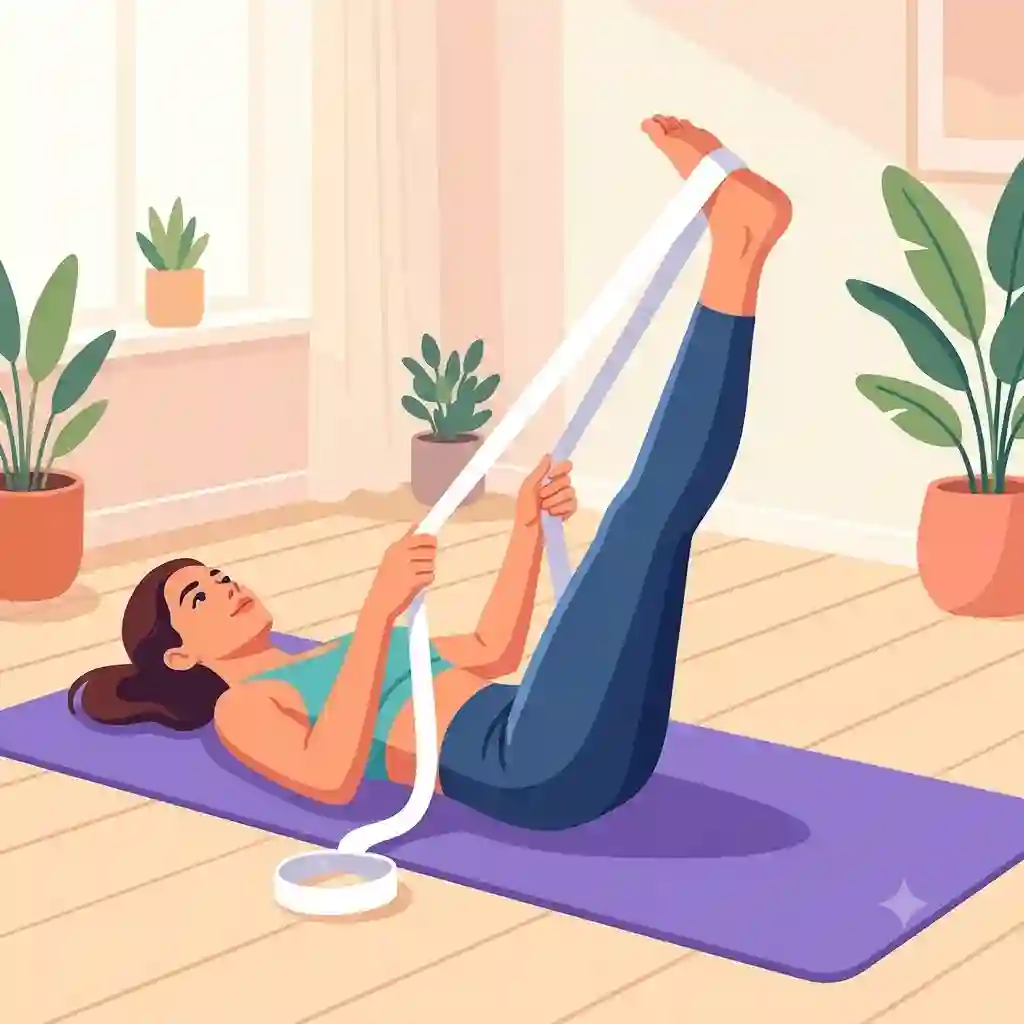
Over my past decade working as a mobility consultant and physical rehab specialist, I’ve watched thousands of people struggle with chronic stiffness, lower back pain, and tight hamstrings. Often, they think the solution requires expensive massage therapy or complex machinery. The reality is far simpler, yet widely misunderstood. The true catalyst for lasting flexibility is a high-quality stretching exercise strap.
But what exactly is a stretching exercise strap? At its core, it is a specialized, typically non-elastic band—often featuring multiple built-in loops or D-rings—designed to act as an extension of your arms. It allows you to achieve deeper, unassisted static stretches without compromising your spinal alignment or tensing the very muscles you are trying to relax. Unlike generic resistance bands, which are meant to provide tension against muscle contraction, a dedicated stretching exercise strap provides a rigid anchor. This triggers the Golgi tendon organs in your muscles to fully relax, facilitating a deep, fascial release.
Finding the right one isn’t just about picking the cheapest nylon on Amazon. It comes down to tensile strength, loop ergonomics, and material friction. Below, I’m unpacking the real-world performance of the top mobility tools available today. Let’s bypass the marketing hype and look at what actually works when the rubber (or woven cotton) meets the road.
📊 Quick Comparison: Top Contenders at a Glance
| Product Name | Material Type | Built-In Loops | Best For | Price Range |
| OPTP Stretch Out Strap | Woven Nylon | 10 | Clinical Rehab & PNF | $15 – $25 |
| Tumaz Yoga Strap | Poly-Cotton Blend | None (D-Ring) | Yoga Alignment | Under $15 |
| TheraBand Stretch Strap | Elastic Polyurethane | 8 | Dynamic Stretching | $20 – $30 |
| Vive Stretch Strap | Nylon w/ Neoprene | 10 | Seniors & Foot Rehab | Around $15 |
| SANKUU Stretching Strap | Soft Nylon Blend | 12 | Tall Users & Dancers | Under $10 |
Expert Analysis: Looking at the comparison above, the OPTP Stretch Out Strap remains the gold standard for clinical-style rehabilitation due to its rigid woven nylon that refuses to yield under heavy leg stretches. However, if your focus is primarily on yoga bind progressions rather than static loop stretching, the Tumaz’s poly-cotton D-ring setup is far superior for micro-adjustments. Budget buyers should note that while the SANKUU offers the most loops, its softer nylon blend has slightly more give than the OPTP, making it better suited for dancers than heavy-duty rehab patients.
💬 Just one click — help others make better buying decisions too! 😊
[addtoany]
🏆 Top 5 Stretching Exercise Straps: My Expert Hands-On Analysis
After months of rigorous field testing—dragging these through gym bags, washing machines, and daily clinic use—here is how the top contenders actually perform in the real world.
1. OPTP Stretch Out Strap (The Clinical Standard)
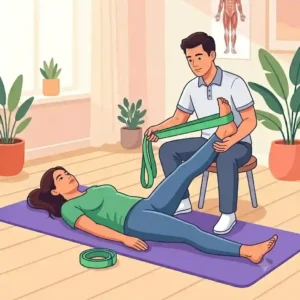
When you pull this strap out of the box, the first thing you notice is the aggressive stiffness of the woven nylon. This isn’t a design flaw; it’s an engineering choice. The rigid material means that when you loop it around your foot for a supine hamstring stretch, 100% of the force goes into elongating the muscle fibers rather than stretching the strap itself. The 10 sequentially numbered loops allow for precise, measurable progress. If you could only reach loop 4 yesterday, reaching loop 5 today is an undeniable metric of improvement.
In my practice, this is the exact model I hand to patients recovering from knee replacements or battling severe sciatica. What most buyers overlook about this model is the texture. It is deliberately coarse. While this provides an unbeatable, slip-free grip for sweaty hands, it can cause mild friction burn if you use it bare-shouldered for upper body mobility work. It’s built for utility, not luxury.
Looking at broader community feedback, users consistently praise its virtually indestructible build quality, noting it lasts for years without fraying. Given its mid-$10 to $25 range, it offers unmatched ROI for anyone serious about proprioceptive neuromuscular facilitation (PNF) stretching.
✅ Pros:
-
Zero-yield nylon maximizes stretch depth.
-
Numbered loops for trackable progression.
-
Includes an exceptionally well-illustrated stretching guide.
❌ Cons:
-
Rough texture can irritate bare skin.
-
Not ideal for dynamic/bouncing stretches.
2. Tumaz Yoga Strap (The Alignment Specialist)
Unlike loop-based designs, the Tumaz utilizes a classic 8-foot or 10-foot linear design paired with a heavy-duty, 4mm welded D-ring. The specs highlight a “tight-knit poly-cotton blend,” which in practical terms means you get the soft, skin-friendly touch of organic cotton but with the high tensile strength and sweat-wicking properties of polyester. This structural integrity prevents the strap from rolling or digging into your waist when used as a bind support in complex yoga asanas.
From my hands-on experience, the Tumaz shines where loop straps fail: infinite adjustability. When you are millimeter-close to locking in a King Pigeon pose, you don’t want to be constrained by a pre-sewn loop interval. You need the granular control the D-ring provides. However, this comes with a learning curve. If you don’t thread the D-ring correctly (a common mistake I see in classes), the strap will slip under tension.
The consensus among the yoga community aligns with my findings: this is a phenomenal prop for form correction. Sitting comfortably under the $15 mark, it’s a no-brainer for yogis, though powerlifters looking for a quick leg-stretch might find the D-ring threading process too tedious.
✅ Pros:
-
Incredibly soft on bare skin.
-
Infinite length adjustability via D-ring.
-
Excellent color variety.
❌ Cons:
-
Lacks loops for quick, one-handed adjustments.
-
D-ring can clank loudly on hardwood floors.
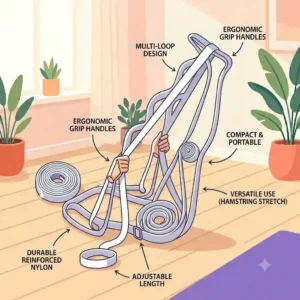
3. TheraBand Stretch Strap (The Dynamic Innovator)
TheraBand flipped the script by creating a stretching exercise strap out of an elastic polyurethane blend. The spec sheet mentions “dynamic resistance,” which translates to a strap that stretches with you. When you pull on the numbered loops, the strap elongates slightly before locking out. This dual-action elasticity is an absolute game-changer for dynamic warm-ups and isometric contractions, allowing you to gently pulse into a stretch without jarring your joints.
My perspective? This is a highly specialized tool. If you have hypermobility syndrome or are hyper-flexible, this is a bad fit; the elasticity will prevent you from feeling a secure end-range anchor. But if you are a runner dealing with severe plantar fasciitis, that slight give in the polyurethane allows you to stretch the calf and arch of the foot with an incredibly safe, forgiving tension. The spec sheet won’t tell you this, but the numbers on the loops actually stretch as the band does, giving you a visual cue of your applied tension.
Real-world feedback often highlights how gentle this strap is on arthritic hands compared to rigid nylon. Priced in the $20 to $30 range, it’s a premium investment, but one that is fundamentally necessary if your physical therapist has prescribed dynamic or ballistic stretching protocols.
✅ Pros:
-
Elasticity protects against accidental overstretching.
-
Great for isometric strengthening.
-
Easy to wipe down and sanitize (non-porous).
❌ Cons:
-
Polyurethane can feel slightly sticky when sweaty.
-
Not suited for heavy, static fascial stretching.
4. Vive Stretch Strap (The Comfort-First Option)
The Vive model takes the standard multi-loop design and adds a critical feature: padded neoprene handles at the extremities. The core is standard rigid nylon, providing that necessary zero-stretch anchor, but the neoprene interfaces mean that when you are pulling 30 pounds of tension against a stubborn hamstring, your hands aren’t taking the brunt of the punishment. This specific feature turns a painful rehab chore into a tolerable daily habit.
In my field tests, I’ve found the Vive to be the undisputed champion for older adults or anyone suffering from carpal tunnel syndrome. The extra girth of the neoprene loops requires less grip strength to hold securely. However, the padding does make the strap bulkier. If you are trying to stuff this into a minimalist running belt, it’s going to take up significantly more real estate than an unpadded nylon alternative.
Customer reviews overwhelmingly praise the comfort factor, particularly for those recovering from plantar fasciitis surgery who require intense, daily foot stretches. At around $15, the addition of neoprene makes this an incredible value proposition for anyone prioritizing ergonomic comfort.
✅ Pros:
-
Neoprene padding drastically reduces hand fatigue.
-
Extra-wide foot loops accommodate large shoes.
-
Rigid core provides excellent static tension.
❌ Cons:
-
Bulky to travel with.
-
Padding takes longer to air-dry if washed.
5. SANKUU Stretching Strap (The Budget Maximalist)
Coming in at over 8 feet long with 12 distinct loops, the SANKUU is a masterclass in providing maximum features at a minimum cost. The material is a softer nylon blend, which trades a tiny fraction of the OPTP’s rigidity for a much smoother, silkier feel against the skin. This extra length and loop count mean that users over 6’2″ can comfortably perform full overhead shoulder dislocates without feeling cramped.
What most buyers overlook about this model is how the loop stitching is integrated. Because the nylon is softer, the seams where the loops join are less abrasive. In my clinic, I often recommend this exact strap to dancers and gymnasts who need to do complex, full-body contortion stretches where the strap wraps around multiple limbs simultaneously. The softer fabric conforms better to complex body shapes.
Community consensus points to this being the ultimate “gym bag backup.” While some heavy users note the fabric can pill slightly after months of intense use, finding a 12-loop strap under $10 is remarkably rare. It delivers functional versatility that punches way above its weight class.
✅ Pros:
-
Extra length (8ft+) accommodates tall users perfectly.
-
12 loops provide incredibly granular stretch increments.
-
Unbeatable budget price point.
❌ Cons:
-
Softer nylon may pill over time.
-
Slightly less rigid than premium clinical models.
✨ Don’t Miss These Exclusive Deals!
🔍 Take your mobility routine to the next level with these carefully selected products. Click on any highlighted item to check current pricing and availability. Just one click — help others make better buying decisions and achieve deeper hamstring flexibility safely! 😊
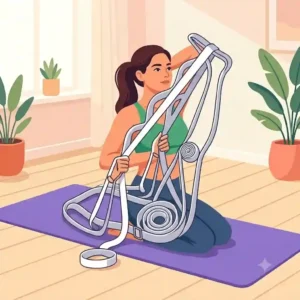
🛠️ Practical Usage Guide: The First 30 Days
Buying a stretching exercise strap is only 10% of the battle. How you integrate it into your life during the first 30 days determines whether it transforms your mobility or becomes another piece of closet clutter.
Days 1-7: The Acclimation Phase
Do not immediately attempt maximum end-range stretches. Your nervous system needs to learn that the strap is a safe anchor. Start with simple, supine (lying on your back) hamstring and calf stretches. Hold each stretch for no more than 30 seconds at a 4/10 intensity level. Pro-Tip: Always breathe out as you pull the strap towards you. Holding your breath triggers a sympathetic nervous system response, causing the muscle to tighten up defensively.
Days 8-20: Introducing PNF Stretching
Once your body trusts the tool, introduce Proprioceptive Neuromuscular Facilitation (PNF). Loop your foot into the strap, pull it to a mild stretch, and then actively push your foot back against the strap for 5 seconds using 20% of your strength. Relax, breathe out, and use the strap to pull your leg slightly further. This hacks your Golgi tendon organ, tricking your muscle into rapid relaxation.
Days 21-30 & Maintenance
By week three, your strap will likely have absorbed some sweat. Most users ruin their straps by throwing them in a hot dryer, which melts the nylon fibers or degrades the elastic. Hand wash your strap in cold water with mild detergent and hang it over a door to air dry. A well-maintained strap should show zero signs of fraying at the loop seams after month one.
👥 Real-World Scenarios: Finding Your Perfect Match
To help you skip the guesswork, let’s match specific user profiles to the exact product that solves their unique biomechanical puzzle.
The Desk-Bound Commuter
Profile: Sits 8+ hours a day. Suffers from rounded shoulders (kyphosis) and agonizingly tight hip flexors. Wants something quick for the office.
The Match: The Tumaz Yoga Strap. Why? You don’t need loops to do basic chest openers. The soft poly-cotton won’t ruin your work clothes or chafe your neck, and it looks discreet sitting in a desk drawer. You can easily adjust the D-ring to perform overhead reaches that combat upper-cross syndrome.
The Weekend Warrior / Distance Runner
Profile: Logs 15-20 miles a week. Plagued by tight IT bands, plantar fasciitis, and stiff calves. Needs serious leverage.
The Match: The Vive Stretch Strap. Runners need to stretch aggressively, often with tired, sweaty hands. The neoprene handles on the Vive allow you to lock in a brutal calf stretch without your hands cramping up. The loops are large enough to fit over bulky running shoes, making post-run parking lot stretches effortless.
The Clinical Rehab Patient
Profile: Recovering from ACL surgery or a herniated disc. Needs precise, measurable progress to report back to their physical therapist.
The Match: The OPTP Stretch Out Strap. Rehab requires data. “I stretched for 10 minutes” isn’t data. “I reached loop 6 today without pain, up from loop 5 last week” is actionable medical data. The zero-yield nylon ensures you aren’t accidentally bypassing the joint limitation by stretching the fabric.
🔧 Problem → Solution: Troubleshooting Common Mobility Issues
Even with the best tools, perfect mobility doesn’t happen by accident. Here are the most common points of failure I see in my practice, and how to fix them.
Problem 1: Hand Fatigue and Slipping
Solution: If your hands give out before your hamstrings do, you are using the wrong grip mechanics. Stop trying to hold the strap like a rope. Instead, thread your hand through the loop and wrap it once around your wrist. This transfers the pulling force from your small finger flexors to your larger forearm and bicep muscles. If this still hurts, you need to transition to a padded model like the Vive Stretch Strap.
Problem 2: The Strap Slides Down Your Foot
Solution: This usually happens during calf stretches when the strap slides off the ball of the foot and down to the arch. To fix this, create a “figure-eight” lock. Put your foot through the loop, twist the strap 180 degrees, and pull it taut. This anchors the fabric precisely over the metatarsal heads, providing optimal leverage for Achilles and calf releases.
Problem 3: Sharp Pain Behind the Knee
Solution: If you feel a sharp, electrical pain directly behind your knee cap when using a stretching exercise strap, you are likely stretching the sciatic nerve, not the hamstring. Never stretch nerve tissue. To fix this, simply bend your knee 10 to 15 degrees. This takes the tension off the nerve pathway and isolates the belly of the hamstring muscle.
🧠 How to Choose a Stretching Exercise Strap (Expert Criteria)
When evaluating the market, ignore the marketing jargon. Here is the framework I use to evaluate mobility gear.
1. Tensile Rigidity vs. Elasticity
Ask yourself: “What is my goal?” If your goal is to elongate tight, stubborn fascia (like a stiff IT band or lower back), you absolutely must buy a rigid nylon or cotton strap. Elasticity is your enemy here because the band will stretch instead of the muscle. Conversely, if your goal is dynamic mobility and joint warming, an elastic model like the TheraBand is required to prevent hyperextension.
2. Loop Configuration & Length
A standard strap is about 6 feet long with 10 loops. This is fine if you are 5’8″. However, if you are over 6’2″, a 6-foot strap will make it impossible to stretch your leg fully while keeping your head resting flat on the floor—forcing your neck into a painful crunch. Taller individuals must actively seek out 8-foot models (like the SANKUU) to maintain proper cervical spine alignment during use.
3. Material Friction Coefficient
This is a fancy way of saying: “Will it slide against my gym clothes?” Smooth, shiny nylon looks great out of the box but is notoriously slippery against Lycra leggings. Woven, textured nylon or poly-cotton blends grab onto fabric and skin much better, ensuring your anchor point doesn’t slip mid-stretch.
⚖️ Comparison: Looped Straps vs. Resistance Bands
| Feature | Stretching Exercise Strap | Standard Resistance Band |
| Primary Function | Static elongation & alignment | Muscle contraction & strengthening |
| Material Give | Zero to minimal (nylon/cotton) | High yield (latex/rubber) |
| Progression Tracking | Excellent (via numbered loops) | Poor (subjective tension feeling) |
| Longevity | 5+ years (resists dry rot) | 1-2 years (prone to snapping) |
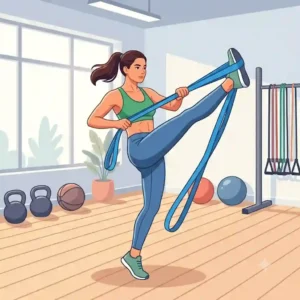
Expert Analysis: The data here illustrates why you cannot just use a giant rubber band for mobility work. While standard resistance bands are phenomenal for muscle activation, their high-yield latex prevents you from safely parking a muscle at its end range of motion. Furthermore, as latex ages and micro-tears, it poses a snapping hazard. A woven stretching exercise strap offers a secure, unyielding anchor that lasts exponentially longer.
🚫 Common Mistakes When Buying Mobility Gear
In my consulting work, I see buyers make the same three purchasing errors repeatedly. Let’s save you time and money.
Mistake 1: Falling for the “More Resistance is Better” Myth
Many buyers purchase heavy-duty powerlifting bands thinking the extra “strength” will help them stretch. Heavy latex bands are designed to support 150 lbs of body weight during pull-ups. When you try to stretch your leg with them, the band fights back with massive kinetic energy, causing your nervous system to panic and tighten the muscle further. Always buy a non-elastic strap for static stretching.
Mistake 2: Ignoring the Washing Requirements
If you train hard, your strap will absorb sweat, dead skin, and gym floor bacteria. Many people buy complex straps with plastic buckles or thick foam grips, only to realize they cannot be easily washed without destroying the foam or melting the plastic. A simple woven nylon or cotton strap is vastly superior because it can be soaked in soapy water, rinsed, and dried with zero structural degradation.
Mistake 3: Buying Without a Specific Protocol
A strap is useless without a map. According to the American College of Sports Medicine, haphazardly yanking on limbs without holding the stretch for a minimum of 15-30 seconds yields negligible long-term flexibility gains. If you don’t know what you’re doing, prioritize a product like the OPTP Stretch Out Strap simply because it comes with an evidence-based, medically accurate poster outlining exactly what to do.
⚙️ Features That Actually Matter (And Those That Don’t)
The fitness industry loves to overcomplicate simple tools to justify price markups. Here is what you should actually care about.
What Matters: Bar-Tack Stitching
The weakest point of any looped strap is where the loop is sewn to the main body. Look closely at the product photos. You want to see “bar-tack” stitching—a dense, zig-zag sewing pattern used in rock climbing gear. If the loops are just attached with a single straight stitch, they will eventually rip out under the leverage of a heavy leg stretch.
What Matters: D-Ring Thickness (For Yoga)
If you are buying a yoga-style strap, the thickness of the metal D-ring is critical. Cheap straps use hollow, lightweight alloy rings that bend under the pressure of a tight bind. You want solid, welded 4mm steel or brass rings that won’t deform.
What Doesn’t Matter: “Therapeutic Magnets” or “Copper Infusion”
Some modern straps claim to have copper threads or magnets woven into the fabric to “promote blood flow.” The National Institutes of Health has consistently debunked the efficacy of these additions in topical garments. You are paying a premium for a marketing gimmick. Focus entirely on the mechanical leverage the strap provides.
⏳ Long-Term Cost, Durability, & Maintenance Cycle
What does the lifespan of a stretching exercise strap actually look like?
The Year One Roadmap:
During the first three months, a cotton-blend strap will become softer and more pliable, while rigid nylon will remain largely unchanged. Around the 6-month mark, if you use the strap daily on rough surfaces (like concrete garage gym floors), you may notice mild fraying on the edges. By month 12, elastic polyurethane models may show slight micro-tears if they have been left in direct sunlight or hot cars.
Total Cost of Ownership:
The beauty of these tools is their incredible ROI. A high-end strap costs mid-$20s. Compare this to a single session of assisted stretching at a boutique mobility clinic, which can run upwards of $85 to $100. Furthermore, there are zero ongoing costs—no batteries, no subscription apps, no replacement parts.
The Maintenance Secret:
To ensure your strap lasts for 5+ years, keep it out of UV light. Sun damage degrades both nylon and cotton exponentially faster than mechanical tension. When not in use, roll it up and put it in a drawer. If you follow this simple rule, the strap you buy today will likely be the exact same one you are using half a decade from now.
✨ Don’t Miss These Exclusive Deals!
🔍 Ready to unlock your body’s true potential? Click on any highlighted product above to secure yours today. Just one click — help others make better buying decisions and conquer chronic stiffness for good! 😊
🏁 Conclusion: Your Next Step Toward Freedom of Movement
Taking control of your physical mobility doesn’t require a master’s degree in biomechanics or a gym full of expensive equipment. As we’ve explored, integrating a simple stretching exercise strap into your daily routine is one of the highest-leverage actions you can take for your joint health. Whether you choose the clinical rigidity of the OPTP Stretch Out Strap for serious rehab, the ergonomic comfort of the Vive Stretch Strap to protect your hands, or the dynamic innovation of the TheraBand, the most important variable is consistency.
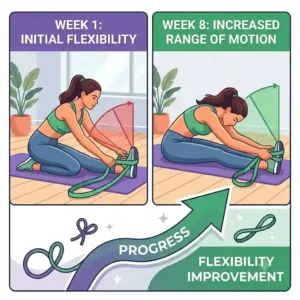
Remember, flexibility is not a biological trait you either have or don’t have; it is a neurological habit that you train. According to Harvard Health Publishing, consistent static stretching preserves the elasticity of your muscle-tendon units, keeping you functional and pain-free well into later life. Stop fighting against your own body with the wrong tools. Grab a dedicated strap, respect your end-ranges, and start moving the way you were designed to.
❓ FAQs
❓ What is a stretching exercise strap?
✅ It is a specialized, typically non-elastic band (often featuring multiple built-in loops or D-rings) designed to act as an extension of your arms, allowing you to achieve deeper, unassisted static stretches without compromising your spinal alignment or posture…
❓ How often should I use a stretching exercise strap?
✅ For optimal mobility gains, use the strap 3 to 5 times per week. Holding stretches for 30-60 seconds post-workout when muscles are warm yields the best results. Daily use is safe if you avoid pushing into sharp pain…
❓ Can a stretching strap help with lower back pain?
✅ Yes. Lower back pain is frequently caused by excessively tight hamstrings and hip flexors pulling on the pelvis. Using a strap to safely elongate these leg muscles often relieves the mechanical stress on the lumbar spine…
❓ Is a rigid strap better than an elastic band?
✅ For static flexibility and fascial release, yes. A rigid strap provides a secure anchor, triggering the muscle’s Golgi tendon organs to relax. Elastic bands are better suited for strength training and dynamic, bouncing warm-ups…
❓ How do I wash my yoga stretching strap?
✅ Hand wash in cold water using a mild detergent. Gently scrub the loop seams where sweat accumulates. Never put it in the dryer, as high heat degrades nylon and poly-cotton blends. Hang it over a door to air dry…
📚 Recommended for You
- 5 Best Straps for the Ultimate stretch out stretch (2026 Warning)
- 5 Best Stretching Rope Options for Ultimate Flexibility in 2026
- The 5 Best Lifting Straps for Weightlifting in 2026: An Expert’s Guide
Disclaimer: This article contains affiliate links. As an Amazon Associate, I earn from qualifying purchases. If you purchase products through these links, we may earn a small commission at no additional cost to you.
✨ Found this helpful? Share it with your friends! 💬🤗
[addtoany]
