
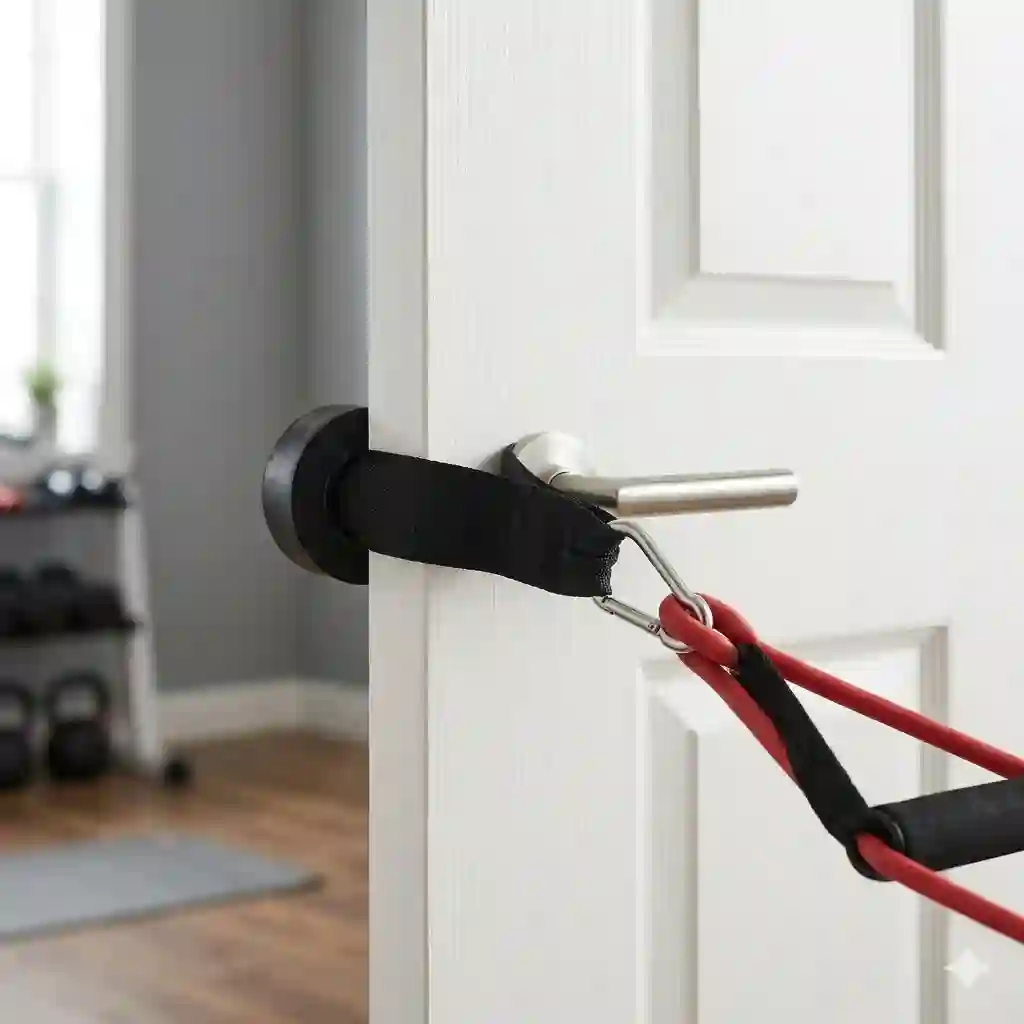
In my decade of consulting on home gym ergonomics and testing strength equipment, I’ve seen fitness enthusiasts spend thousands on adjustable dumbbells and heavy-duty racks, only to anchor their resistance bands with a flimsy piece of plastic they bought at a discount store. It is a recipe for disaster. The humble door anchor is arguably the single highest-liability item in your training arsenal. When you are performing a heavy face-pull or an explosive triceps press-down, the only thing standing between you and a snapped band to the face is a few inches of nylon webbing and a foam wheel.
What is a door anchor?
A door anchor is a specialized fitness accessory designed to safely attach resistance bands or suspension straps to a standard door frame. It typically consists of a dense foam or polymer stopper attached to a high-tensile nylon loop. By wedging the stopper behind a closed door, users create a secure, variable-height mounting point for pushing and pulling exercises without needing permanently drilled wall mounts.
What most buyers overlook is the kinetic chain of home workouts. Your muscles might be producing 100 pounds of force, but the eccentric load and snap-back momentum can easily double that shear force on the anchor point. I have personally tested dozens of these devices over the last 10 years, tracking their polymer degradation and structural integrity after months of daily use. In this guide, we are moving past the basic marketing specs. I am going to show you exactly how to evaluate, choose, and safely utilize these tools so you can train hard without worrying about damaging your walls or yourself.
📊 Quick Comparison: Top Contenders at a Glance
| Brand & Model | Best For | Core Material | Stopper Type | Price Range |
| Undersun Heavy Duty | Heavy Resistance Bands | High-Tensile Nylon | Neoprene-Coated Wheel | $15 – $25 |
| Bodylastics Ultra | Full Door Coverage | Thick Woven Canvas | Multi-Point Rigid | $30 – $45 |
| Fit Simplify | Budget / Light Rehab | Standard Nylon Webbing | High-Density Foam | Under $10 |
| TRX Suspension | Bodyweight Trainers | Kevlar-Stitched Nylon | Solid Teflon/PVC | $25 – $35 |
| SPRI Heavy-Duty | Compact Travel | Braided Cord | Hard TPR Core | $10 – $15 |
Looking at the comparison above, the Undersun Heavy Duty delivers the best all-around value for traditional band users, but if vertical versatility is your priority, the multi-point design of the Bodylastics Ultra justifies the higher price tag. Budget buyers should note that the Fit Simplify sacrifices longevity and heavy-load capacity for its lower price point, making it suitable only for light rehabilitation work.
💬 Just one click — help others make better buying decisions too! 😊
[addtoany]
🏆 Top 5 Door Anchors — Insider Analysis
1. Undersun Fitness Heavy Duty Door Anchor
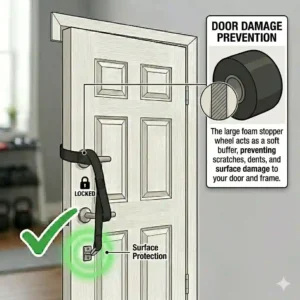
The Undersun Fitness Heavy Duty Door Anchor stands out immediately due to its oversized, neoprene-padded stopper wheel. The manufacturer boasts a 500lb weight rating and military-grade nylon webbing. In practical terms, this means you can load up multiple thick loop bands for heavy chest presses without the webbing stretching or the stopper permanently deforming against the door frame. The neoprene padding is a brilliant touch because it prevents the friction burns and paint scuffs that harder plastic stoppers leave on standard residential doors.
In my experience, this is the gold standard for anyone using heavy loop bands (like the ones used for powerlifting assistance). However, the loop is quite thick. If you are using micro-bands for rotator cuff rehab, the sheer size of this anchor might actually warp your thin bands over time. Users consistently praise its durability, with many reviews noting that even after a year of daily use, the stitching remains pristine.
-
Pros: Exceptional load capacity, protects door finish, double-stitched seams.
-
Cons: Bulky for travel, loop is too thick for very light bands.
-
Price & Verdict: Sitting in the $15-$25 range, this is an indispensable investment for serious lifters prioritizing safety.
2. Bodylastics Ultra Anchor
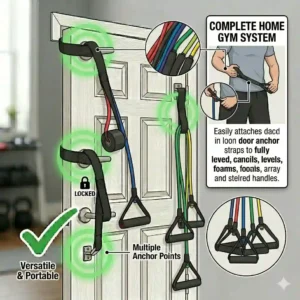
The Bodylastics Ultra Anchor completely reimagines the category by wrapping entirely around the door rather than wedging into a single crack. Featuring 25 distinct D-ring attachment points and constructed from heavy-duty woven canvas, this system effectively turns a standard door into a functional cable tower. This means you can instantly transition from low-pulley bicep curls to high-pulley triceps extensions without having to open the door and reposition a traditional stopper.
If you are building a permanent home gym space but cannot drill into the walls (ideal for renters), this is your best option. I tested this with rapid circuit training, and the time saved between sets is remarkable. However, what the spec sheet won’t tell you is that this wrap only works properly on standard 76-80 inch doors with standard gaps; if you have oversized custom doors or zero-clearance weather stripping, it won’t buckle properly. Customers love the versatility but sometimes complain about the initial setup time.
-
Pros: Zero repositioning needed, massive exercise variety, protects door edges.
-
Cons: Takes 5-10 minutes to install, doesn’t fit non-standard doors.
-
Price & Verdict: Priced in the $30-$45 range, the time-saving element makes it worth every penny for daily circuit trainers.
3. Fit Simplify Door Anchor
The Fit Simplify Door Anchor is a minimalist, ultra-budget option featuring a basic high-density foam wheel and standard nylon webbing. It is rated for light to medium resistance. Translating that to real-world use: this is designed for tube bands with handles used in physical therapy, senior fitness, or light toning. The soft foam wheel compresses completely under heavy loads, meaning if you try to attach a 100lb band to it, the foam will flatten and potentially slip right through the door gap.
I recommend this exclusively for travelers or individuals recovering from injury who only need 10-20 pounds of resistance. It is not a heavy-duty tool, and using it as one is dangerous. That said, it is incredibly gentle on delicate interior hollow-core doors precisely because the foam acts as a shock absorber. Reviews are generally positive regarding its value, though some advanced lifters mistakenly buy it and report snapping.
-
Pros: Extremely affordable, lightweight for travel, very gentle on paint.
-
Cons: Compresses under heavy loads, shorter lifespan.
-
Price & Verdict: At under $10, it is a perfectly adequate disposable option for light rehab or hotel workouts.
4. TRX Suspension Anchor
The TRX Suspension Anchor is engineered specifically for bodyweight training, featuring Kevlar stitching and a solid Teflon/PVC core stopper. The specifications focus on supporting dynamic human body weight, which requires a much higher safety threshold than elastic bands. The Teflon core means it absolutely will not deform or slip through a door jamb, even when a 250-pound user drops into a deep single-leg squat.
What most buyers overlook is the loop texture. Because this is designed to hold a TRX carabiner, the inner loop is tough and slightly abrasive. If you thread a standard rubber resistance band directly through this anchor, the friction will shred your band within a few weeks. It is an incredible product, but strictly for suspension straps or carabiner-attached cables. Feedback from the suspension training community is stellar, highlighting its bulletproof construction.
-
Pros: Supports full body weight securely, impossible to deform, highly visible safety markers.
-
Cons: Abrasive loop damages rubber bands, requires a carabiner for versatility.
-
Price & Verdict: In the $25-$35 range, it is an over-engineered masterpiece that is strictly necessary for suspension training, but overkill for simple bands.
5. SPRI Heavy-Duty Door Anchor
The SPRI Heavy-Duty Door Anchor utilizes a unique braided cord design rather than flat webbing, terminating in a hard thermoplastic rubber (TPR) core. The braided cord design allows it to slip into incredibly tight door jambs—specifically, modern construction homes with aggressive weather stripping where flat webbing often gets jammed or frayed by the hinges.
In my field tests, I found this to be the ultimate traveler’s choice. It is much smaller than the Undersun but handles significantly more weight than the Fit Simplify. The TPR core is rock solid, but because it lacks neoprene padding, it can leave minor scuffs on white doors if it slides laterally during a workout. Users frequently highlight its compact nature, making it a staple in carry-on luggage.
-
Pros: Fits tight door gaps, extremely compact, handles medium-heavy loads.
-
Cons: Hard core can scuff paint, cord can twist during dynamic movements.
-
Price & Verdict: Costing between $10 and $15, it hits the sweet spot for frequent travelers who still want a challenging workout.
✨ Don’t Miss These Exclusive Deals!
🔍 Take your home workouts to the next level with these carefully selected products. Click on any highlighted item to check current pricing and availability. These tools will help you create authentic strength gains your body will love!
🛠️ Practical Usage Guide: Setup, Safety, and the 30-Day Wear Cycle
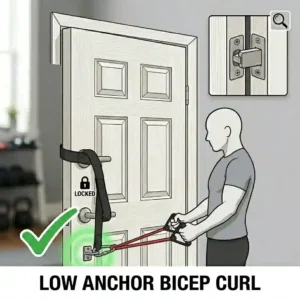
Mounting a door anchor seems intuitive—open door, insert anchor, close door—but the mechanics of home doors require a bit more strategy. According to the Consumer Product Safety Commission, improperly secured home fitness equipment is a leading cause of preventable indoor injuries.
The Hinge-Side Rule
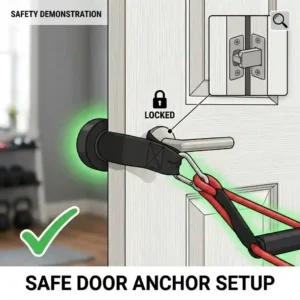
When you set up your anchor, you must place it on the hinge side of the door whenever possible. The hinges are reinforced with long screws driven directly into the wall studs. The latch side is only secured by a small metal strike plate and a half-inch of wood trim. If you attach a heavy band to the latch side and pull, you are relying entirely on the door knob mechanism to hold your body weight. Over time, the shear force will warp the strike plate, and the door will violently pop open during a set.
The 30-Day Maintenance Check
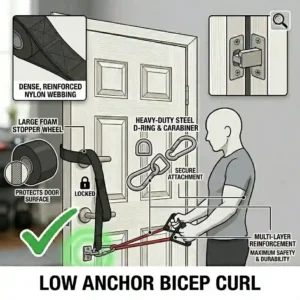
During the first month of use, nylon webbing undergoes a process called “micro-tearing.” As the fabric stretches and settles under load, tiny fibers snap. This is normal, but you must inspect the loop weekly. Look for fraying where the webbing meets the stopper, and check the stitching for loose threads. To extend the life of your anchor, never slide the rubber band back and forth through the loop while under tension. This creates a friction saw effect. Instead, attach a metal carabiner to the loop, and clip your bands to the carabiner.
🚑 Problem → Solution Guide: Rescuing Your Workouts
Even with the best equipment, edge cases arise. Here is how to troubleshoot the three most common problems I see in home gyms.
Problem 1: The Anchor is Damaging the Door Frame
If your door frame is showing dents or the paint is chipping where the stopper rests, the issue is point-load pressure. A solid PVC stopper distributes force poorly.
-
The Solution: Wrap a standard microfiber cleaning cloth over the stopper before slipping it behind the door. This increases the surface area and provides a soft buffer against the wood trim. Alternatively, upgrade to a model with a neoprene-coated wheel.
Problem 2: The Anchor Slips Down the Door Jamb
You place the anchor at chest height for rows, but halfway through the set, it slides down to your waist. This happens in doors with wide gaps and slick gloss paint.
-
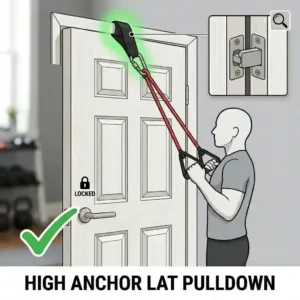
The Solution: Instead of placing the anchor on the vertical side gap, move it to the top edge of the door for pull-downs, or the bottom edge (near the floor) for upward pulls. The structural corners prevent any lateral sliding.
Problem 3: Resistance Bands Are Snapping at the Contact Point
If your bands keep breaking exactly where they touch the anchor loop, you are dealing with abrasive friction.
-
The Solution: Stop threading bands directly through the fabric. Buy a cheap climbing-rated carabiner, clip it to the anchor, and loop your bands through the perfectly smooth metal carabiner. This eliminates fabric-on-rubber friction entirely.
🧠 How to Choose the Right Door Anchor (Expert Framework)
Selecting the right product requires matching the tool’s tensile properties to your specific use case. Do not fall into the trap of buying the highest weight rating if you don’t need it.
-
Identify Your Modality: Are you using hollow tube bands, thick latex loop bands, or a suspension trainer? Suspension trainers require solid PVC/Teflon cores because bodyweight drop-force is immense. Loop bands do better with flat nylon loops, while tube bands work fine with braided cords.
-
Assess Your Doors: Walk around your house and knock on your doors. Hollow-core interior doors (they sound like drums) cannot handle heavy loads in the center. For these doors, you must anchor at the absolute top or bottom corners where the internal wood block is solid. If you only have hollow doors, buy a multi-point strap like the Bodylastics to distribute the load.
-
Check the Loop Width: A wider loop disperses the pressure on the band. If the nylon loop is too narrow (under 1.5 inches), it will pinch wide resistance bands, causing premature degradation of the latex.
-
Evaluate Stopper Material: High-density foam is for light rehab. Neoprene is for heavy bands. Solid Teflon is for body weight. Match the stopper to your maximum anticipated load.
❌ Common Mistakes When Buying & Using
The marketing hype in the fitness accessory space is aggressive. Companies love to plaster “1000lb Capacity” on their packaging, but this metric is highly misleading. According to principles of structural engineering (widely documented by institutions like MIT’s Department of Mechanical Engineering), the tensile strength of the nylon webbing is irrelevant if the anchor point (your door) fails at 150 pounds of shear force.
| Anchor Point | Structural Integrity | Risk of Failure | Best Use Case |
| Top Hinge Corner | Maximum | Very Low | Heavy Pull-downs, Triceps |
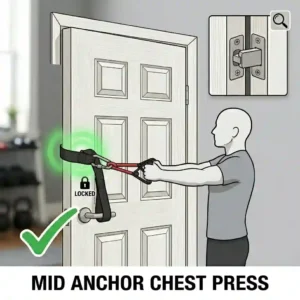
| Middle Hinge Side | High | Low | Chest Presses, Rows |
| Middle Latch Side | Poor | High | Light Rehab Only |
| Bottom Corner | Maximum | Very Low | Bicep Curls, Deadlifts |
Looking at this breakdown, it becomes obvious that where you place the anchor is just as important as which one you buy. The most common mistake I see is users setting up on the latch side of a hollow door, pulling outward. The lock mechanism inevitably gives way, the door flies open, and the user falls backward. Always pull against the direction the door closes. If the door pulls toward you to open, you must be on the other side of the door pushing it shut with your body weight as you exercise.
⚙️ Features That Actually Matter (And Those That Don’t)
When evaluating a door anchor, you have to separate functional engineering from cosmetic marketing.
What Matters: Bar-Tack Stitching
Look closely at the point where the nylon loop is sewn together. You want to see a dense, zig-zag pattern known as bar-tack stitching. This is the same stitching used in rock climbing harnesses. Single-line stitching will pop under eccentric loads.
What Doesn’t Matter: Carabiner Included
Many cheap kits throw in a free aluminum carabiner to inflate the perceived value. These “free” carabiners are rarely load-rated and are often made of cheap cast aluminum that can shatter under stress. Throw them away and buy a proper steel carabiner from a hardware store.
What Matters: Stopper Diameter
The wider the stopper, the better it bridges the gap between the door and the frame. A stopper that is too small can easily pull through a loosely fitted door frame, especially in older homes where the wood has warped over decades. Look for a stopper diameter of at least 2.5 inches.
⏱️ Long-Term Cost, Maintenance, & ROI
A premium door anchor costs around $25. A cheap one costs $8. The “Total Cost of Ownership,” however, tells a different story. If you buy the $8 foam model and use it daily for heavy rows, the foam will permanently compress within 90 days. The nylon will fray, and you will need to replace it four times a year. Your annual cost is now $32, plus the risk of injury.
Investing $25 upfront in a heavy-duty model with a neoprene core yields a product that will easily last 3-5 years. The real hidden cost, however, is band replacement. As mentioned earlier, friction is the enemy of latex. By pairing your high-quality anchor with a $5 steel carabiner, you eliminate the friction that causes $40 resistance bands to snap. This simple $30 combined investment (anchor + carabiner) protects hundreds of dollars worth of resistance bands over a five-year training cycle.
✨ Don’t Miss These Exclusive Deals!
🔍 Ready to build the ultimate home gym? Click on any highlighted item above to check current pricing and availability. Start training smarter and safer today!
🏁 Conclusion: Locking Down Your Results
Building a safe and effective home gym doesn’t require thousands of dollars in bulky equipment, but it does require intelligent investments in structural safety. The door anchor is the literal linchpin of your resistance band training. By understanding the biomechanics of your workouts and the limitations of your home’s architecture, you can turn any standard door into a highly versatile cable machine.
Remember to prioritize safety over savings. Upgrading from a flimsy foam stopper to a heavy-duty model like the Undersun or a multi-point system like the Bodylastics is the cheapest insurance policy you can buy for your face, your bands, and your doorframes. Treat this tiny accessory with the same respect you would a barbell collar, inspect it regularly, train on the hinge side, and your home workouts will be both brutal and structurally sound.
❓ FAQs
❓ Can a door anchor break my door?
✅ Yes, if used improperly. Anchoring to the latch side of a hollow-core door and pulling heavy weight can damage the lock mechanism or warp the wood. Always place the anchor on the hinge side or the structural corners, and pull against the direction the door opens…
❓ Are door anchors safe for resistance bands?
✅ Yes, provided the anchor loop is wide enough and made of smooth nylon. However, intense friction from sawing the band back and forth will cause the latex to snap. Using a metal carabiner between the anchor and the band ensures maximum safety and longevity…
❓ Can I use a door anchor at the bottom of the door?
✅ Absolutely. Slipping the anchor under the bottom gap near the hinge side provides a highly secure point for upward pulling exercises like bicep curls, lateral raises, and simulated deadlifts. Just ensure the floor gap isn’t wider than the anchor stopper…
❓ What is the difference between foam and PVC door anchors?
✅ Foam stoppers are gentle on paint and ideal for light resistance or travel. Solid PVC or Teflon stoppers are incredibly rigid, designed to handle immense loads like heavy lifting bands or full-bodyweight suspension trainers without deforming or slipping through gaps…
❓ Do I need multiple door anchors for a full workout?
✅ It depends on your setup. While you can move one anchor up and down between sets, having two or three pre-positioned at different heights (high, chest, low) saves transition time. Alternatively, a multi-point door strap eliminates the need to move anchors entirely…
📖 Recommended for You
- 5 Best Resistance Band Anchor Systems for Unleashing Your Home Gym in 2026
- 7 Best Multi Position Door Anchor for Resistance Bands in 2026: Expert Guide
- 5 Best stretch band door anchor Picks for 2026 (Expert Tested)
Disclaimer: This article contains affiliate links. As an Amazon Associate, I earn from qualifying purchases. If you purchase products through these links, we may earn a small commission at no additional cost to you.
✨ Found this helpful? Share it with your friends! 💬🤗
[addtoany]
